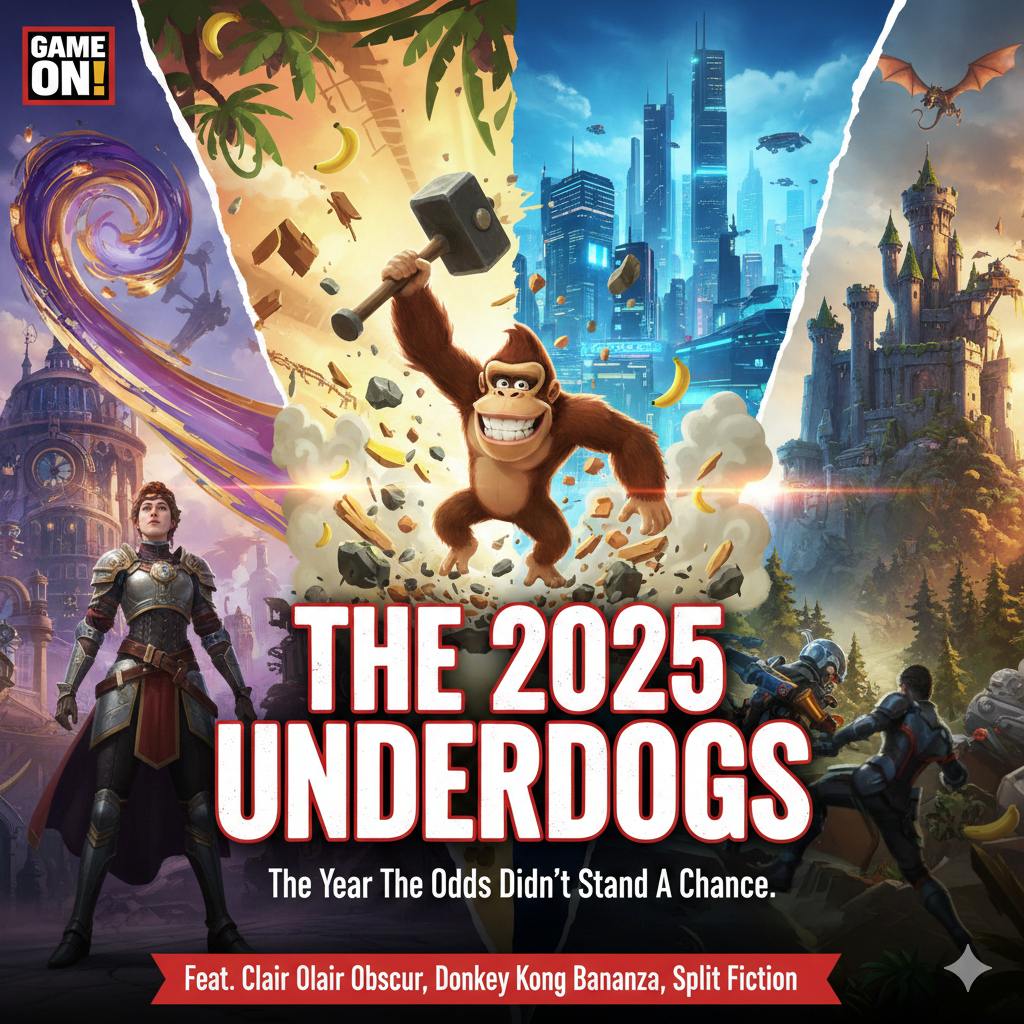
If you asked any industry analyst in January what the biggest stories of 2025 would be, they likely would have pointed to the guaranteed juggernauts. They would have bet the house on the safe, focus-tested AAA sequels or the massive open-world RPGs that had been marketing themselves for half a decade.
Instead, 2025 became the year the titans stumbled. We watched in awkward silence as highly anticipated blockbusters like Avowed launched to a collective “shrug” from the community, and technical disasters turned guaranteed hits like the PC port of Monster Hunter Wilds into cautionary tales about optimization.
But in the vacuum left by these underperforming giants, something remarkable happened. Games that were written off as “too niche,” “too gimmicky,” or “too dated” didn’t just survive—they thrived. Against a backdrop of skepticism, these three titles didn’t just succeed; they saved the year.
1. Clair Obscur: Expedition 33
The Narrative: “Turn-Based is Dead.” The Reality: TIME Magazine’s Game of the Year.
When Sandfall Interactive, a relatively unknown French studio, first revealed Clair Obscur: Expedition 33, the internet’s reaction was a mix of curiosity and dismissal. It looked gorgeous, sure—the Belle Époque art style was undeniable—but the gameplay reveal carried a “fatal” flaw for modern mainstream audiences: it was a turn-based RPG.
In an era dominated by real-time action and frantic battle royales, a debut studio banking on a “slow” genre felt like commercial suicide. Critics whispered that it was too ambitious for a first project, predicting a “style over substance” 7/10 that would be forgotten in a week.
They were wrong. Released in April, Expedition 33 didn’t just revive the genre; it evolved it. By integrating real-time dodge and parry mechanics into the traditional turn-based structure, Sandfall created a rhythm that felt electric. It wasn’t just about waiting for your turn; it was about survival in the active moments between them.
Coupled with a heartbreaking narrative about “The Paintress”—an entity erasing humanity by age groups—the game resonated emotionally in a way few expected. It is currently sweeping award season, proving that “outdated” mechanics are only outdated until someone reinvents them.
2. Donkey Kong Bananza
The Narrative: “Just a tech demo for the Switch 2.” The Reality: A 10/10 Masterpiece.
When Nintendo announced Donkey Kong Bananza as a launch window title for the Switch 2, the skepticism was palpable. The trailers focused heavily on a “destruction” mechanic where DK could smash through almost any terrain. To the cynical eye, it looked like a glorified tech demo designed solely to show off the new console’s physics engine—a shallow gimmick destined to wear thin after two hours.
Reddit threads pre-launch were filled with worry: “Is this even a platformer anymore?” “It looks too easy.” “It’s just a collectathon for kids.”
Then the reviews dropped in July. IGN slapped a rare 10/10 on it, calling it a “brilliant successor to Mario Odyssey.” The “gimmick” of destruction turned out to be a profound puzzle-solving tool, allowing players to literally carve their own paths through the levels. It possessed an infectious, chaotic energy that the polished-but-safe competition lacked. Bananza proved that even a 40-year-old ape could learn new tricks, provided you give him a sledgehammer and a fully destructible environment.
3. Split Fiction
The Narrative: “The Sophomore Slump.” The Reality: A Genre-Bending Co-op Triumph.
Hazelight Studios had a massive target on their back. After It Takes Two won Game of the Year in 2021, the expectation was that their next game, Split Fiction, couldn’t possibly strike lightning twice. The premise—a co-op game where one player is in a Sci-Fi world and the other in a Fantasy world, swapping genres in real-time—sounded messy on paper. It risked being over-complicated and inducing “co-op fatigue” in a market that rarely supports the genre.
Released in March, Split Fiction silenced the doubters immediately. GameSpot awarded it a perfect score, praising the “mind-bending” integration of the two contrasting worlds.
Rather than feeling disjointed, the clash between Sci-Fi and Fantasy became the game’s greatest strength. The “final level”—which we won’t spoil here—is already being hailed as one of the most innovative sequences in gaming history. Josef Fares and his team didn’t just avoid the sophomore slump; they vaulted over it, cementing themselves as the Pixar of video games: a studio that simply doesn’t know how to miss.
The Lesson of 2025
If there is a through-line for 2025, it is that “safe” is dangerous. The games that played it safe this year were the ones that were forgotten. The games that took risks—betting on turn-based combat, destructible physics, and asymmetric co-op—were the ones that reaped the rewards.
As we look toward 2026, publishers would do well to remember the “failures” of 2025. It turns out, the only thing players really want is to be surprised.